Commonwealth Summit in Antigua Ratifies $15 Billion Maritime Climate Resilience Accord
Fifty-six member states establish binding multilateral fund to reinforce vulnerable island coastlines, protect coral barriers, and decarbonize shipping lanes.
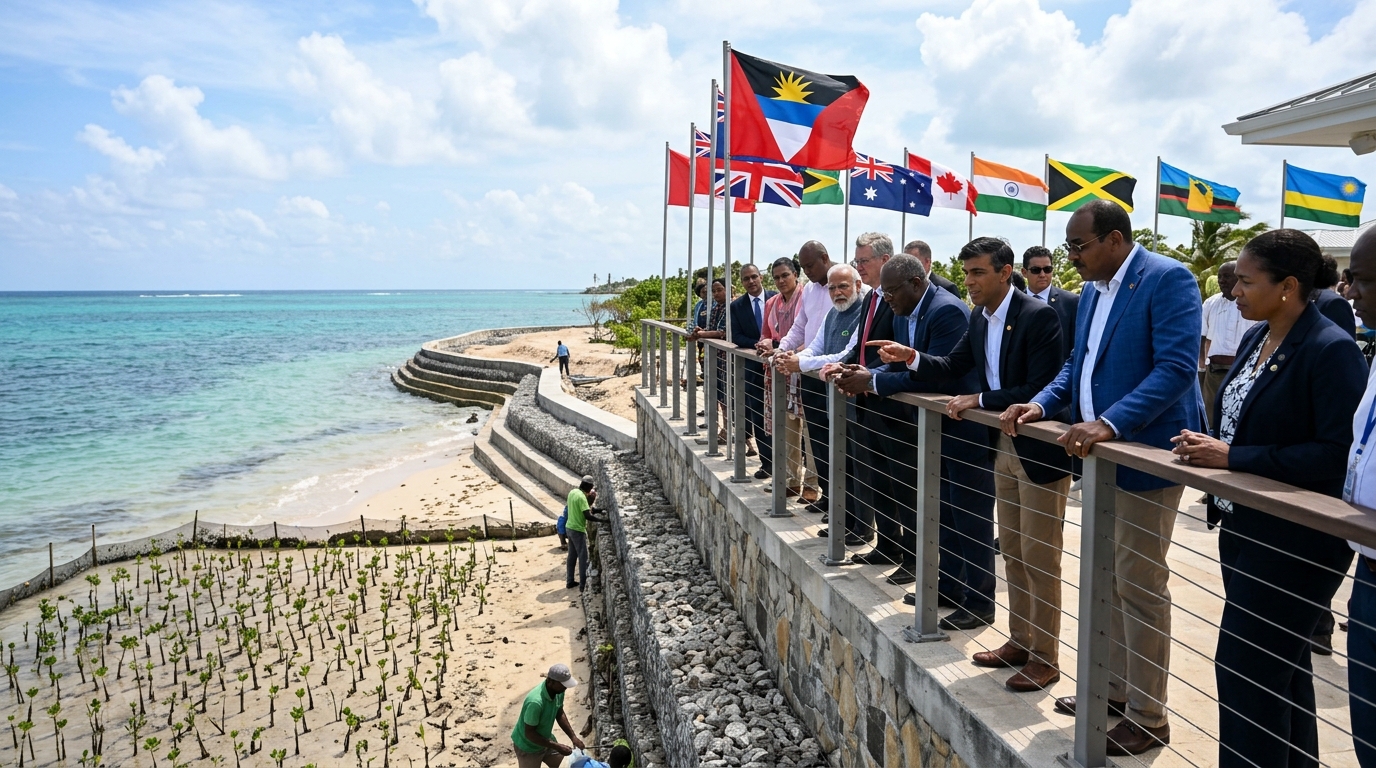
Delegates overlook the Caribbean coastline during the final plenary session of the Commonwealth Heads of Government Meeting in St. John’s.
Commonwealth Summit in Antigua Ratifies $15 Billion Maritime Climate Resilience Accord
ST. JOHN’S, ANTIGUA — Leaders representing fifty-six Commonwealth nations concluded their biennial summit on Wednesday by unanimous adoption of the historic St. John’s Maritime Accord, establishing a $15 billion capital facility committed to small-island climate resilience and ecological coastal engineering.
The accord, finalized after four days of intensive negotiations chaired by Caribbean and Pacific heads of state, creates an emergency capitalization window to finance sea-wall construction, mangrove reforestation, ocean warming telemetry networks, and sustainable maritime shipping infrastructure across thirty-two small island developing states.
Core Pillars of the Accord
- Sovereign Debt Relief Mechanisms: Climate vulnerability clauses will be integrated into bilateral lending, suspending debt service obligations following Category 4 and 5 tropical cyclone strikes.
- Nature-Based Coastal Defense: A minimum of $4.5 billion is ring-fenced for living breakwaters, coral reef restoration, and coastal wetland preservation.
- Decarbonized Island Transit: Transition funds will support the electrification of inter-island ferry fleets and the installation of solar-powered port microgrids.
"Small island states have contributed negligible fractions to global greenhouse emissions, yet our communities confront the frontlines of ocean surges," declared Antigua and Barbuda's Prime Minister during the plenary closing ceremony. "Today's pact shifts the conversation from passive sympathy to active, contractual multilateral capitalization."
Capital Commitments and Allocation Schedule
| Fund Program Area | Total Allocation ($ USD) | Primary Implementing Regions | 5-Year Target Metric |
|---|---|---|---|
| Coastal Infrastructure & Seawalls | $5.2 Billion | Caribbean & South Pacific | 1,400 km of Reinforced Shoreline |
| Living Mangrove & Reef Restoration | $4.8 Billion | Indo-Pacific & Atlantic Basin | 250,000 Hectares Marine Sanctuary |
| Clean Maritime Corridors | $3.2 Billion | Inter-Island Commonwealth Routes | 45% Emission Reduction by 2032 |
| Emergency Rapid Liquidity Reserve | $1.8 Billion | Small State Disaster Facilities | 48-Hour Disaster Cash Deployment |
Multilateral Endorsement
Representatives from the United Nations Environment Programme and the Caribbean Development Bank commended the accord's legal framework, pointing to its direct community-level deployment criteria as a model for upcoming global climate negotiations.
Sarah Jenkins
Environmental & Climate Correspondent
Sarah Jenkins is an award-winning investigative journalist specializing in climate policy, renewable energy transitions, and ecological governance.