Kyoto International Heritage Biennale Celebrates Living Wooden Pagoda Architecture and Craft Restoration
Master joiners and timber conservators from six continents gather in historic Kyoto to showcase millennial mortise-and-tenon seismic engineering for sustainable modern architecture.
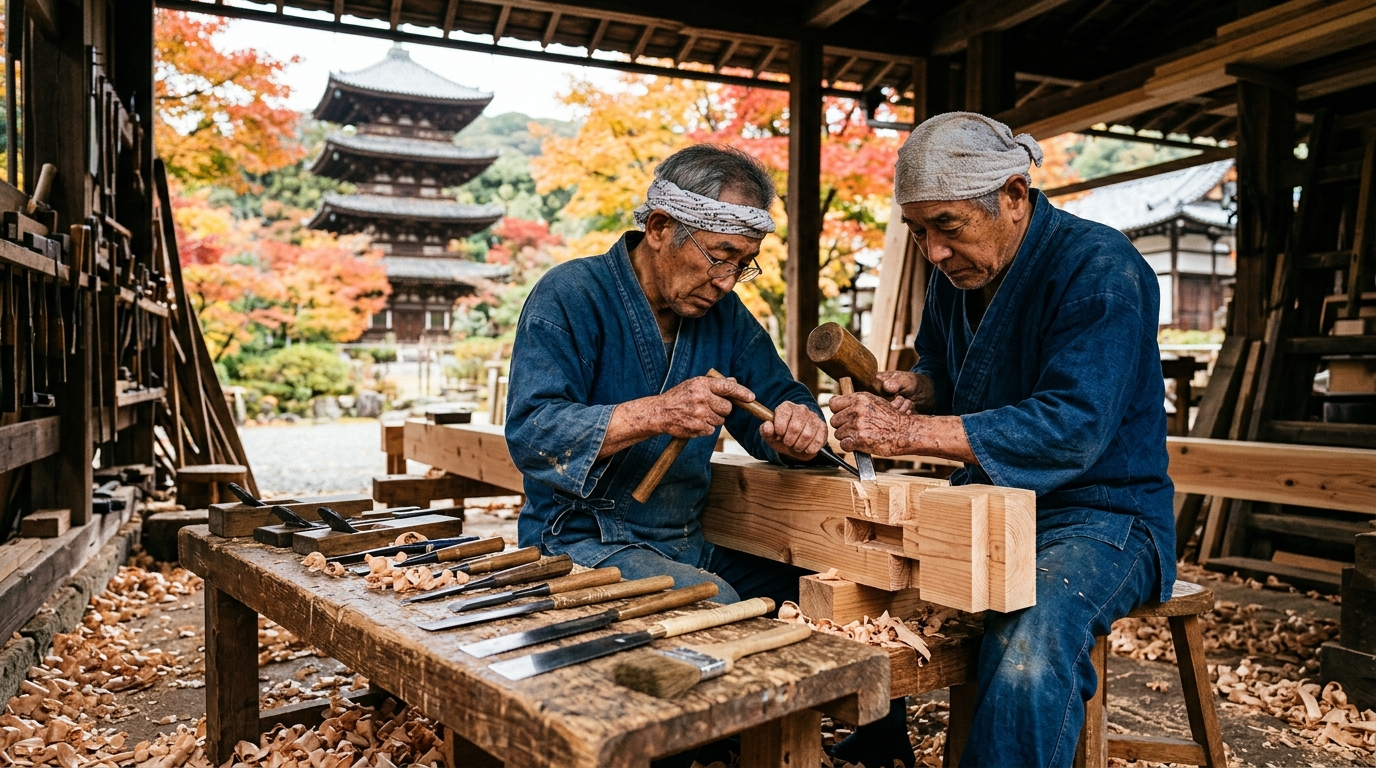
A master carpenter fits interlocking timber joints without nails inside a traditional workshop in Kyoto on Saturday.
Kyoto International Heritage Biennale Celebrates Living Wooden Pagoda Architecture and Craft Restoration
KYOTO — In the serene cedar temple precinct of Daitoku-ji in Kyoto on Saturday, the World Heritage Architectural Biennale opened with a celebration of traditional Japanese joinery (kigumi) as the foundation for the future of sustainable zero-carbon construction.
Master temple carpenters (miya-daiku) demonstrated intricate multi-directional mortise-and-tenon joints crafted entirely without metal nails or synthetic glues—techniques that have allowed five-story wooden pagodas to withstand violent earthquakes and typhoons for more than twelve centuries.
Ancient Wisdom Inspiring Modern Superstructures
- Flexible Central Shinbashira Dynamics: Modern structural engineers presented seismic damping systems for 40-story mass-timber residential towers that mirror the free-swinging central pillar (shinbashira) of classical pagodas.
- Carbon-Negative Urban Architecture: Substituting structural steel and concrete with sustainably harvested, compressed cross-laminated timber (CLT) locks atmospheric carbon directly into municipal skylines.
- Generational Forestry Apprenticeship: A multilateral declaration signed in Kyoto establishes cross-continental apprentice exchanges between Scandinavian timber architects, Canadian indigenous master carvers, and Japanese traditional artisans.
"A pagoda is not an unmoving stone barrier; it is a flexible dancer that harmonizes with the tremors of the earth. In an age of climate emergency, ancient wood teaches us how to build in rhythm with nature," observed Clara Moretti from Kyoto.
Architectural Performance Metrics
| Structural Construction Type | Embodied Carbon (kg CO2/m2) | Seismic Dissipation Capacity | Projected Structural Lifespan |
|---|---|---|---|
| Traditional Reinforced Concrete | +480 kg (Emitted) | Rigid (Cracks under 7.5+ Mag) | 60–80 Years |
| Standard Steel Frame | +390 kg (Emitted) | Elastic with Dampers | 75–90 Years |
| Kyoto Modular Mass-Timber (Kigumi) | -210 kg (Sequestered) | Kinetic Dynamic Damping | Over 600 Years (Verified) |
Public Exhibitions
The Biennale’s interactive workshops will continue through late November across Kyoto's historic temple gardens, drawing thousands of international visitors and architecture students.
Clara Moretti
Senior Cultural Critic & Essayist
Clara Moretti writes on literature, contemporary fine arts, philosophy, and global cultural developments from Paris and Rome.